
Ask any employer in Uganda how their last hire went and you will hear the same story.
The job went up on a Monday. By Wednesday the applications started coming. By Friday there were 80. By the following Wednesday, 200. By the end of two weeks, the recruiter had a folder with 340 CVs, a spreadsheet with half of them half-updated, and a nagging feeling that they had already lost the best candidate to a competitor.
The hire eventually happened six weeks later. But not because there was a shortage of talent. Because nobody could get through the pile fast enough.
This is the real hiring bottleneck in 2026, and it is not a shortage problem. It is a filtering problem.
The 340 CVs problem
Every recruiter knows how to spot a strong candidate. Show them a good CV and they will pick it out in thirty seconds. Ask them to do that three hundred times in a row, and everything changes.
Attention drops. Standards drift. By CV number 150, the reader is skimming. By CV number 250, they are pattern-matching on job titles alone. The best candidate in the pile might be number 312, and by then the reader has lost the patience to give it a fair shot.
This is not a discipline problem. It is a human limitation. The person sorting through those 340 CVs is doing their best, but they are doing it at 11pm on a Thursday after a full day of meetings, and the pile keeps growing.
So the strongest candidate gets buried, and the employer hires the one who happened to land on page one.
What "AI shortlisting" actually means (and what it does not)
There is a lot of noise about AI in hiring. Some of it is marketing fluff, and some of it is genuinely a step forward. Here is the honest version.
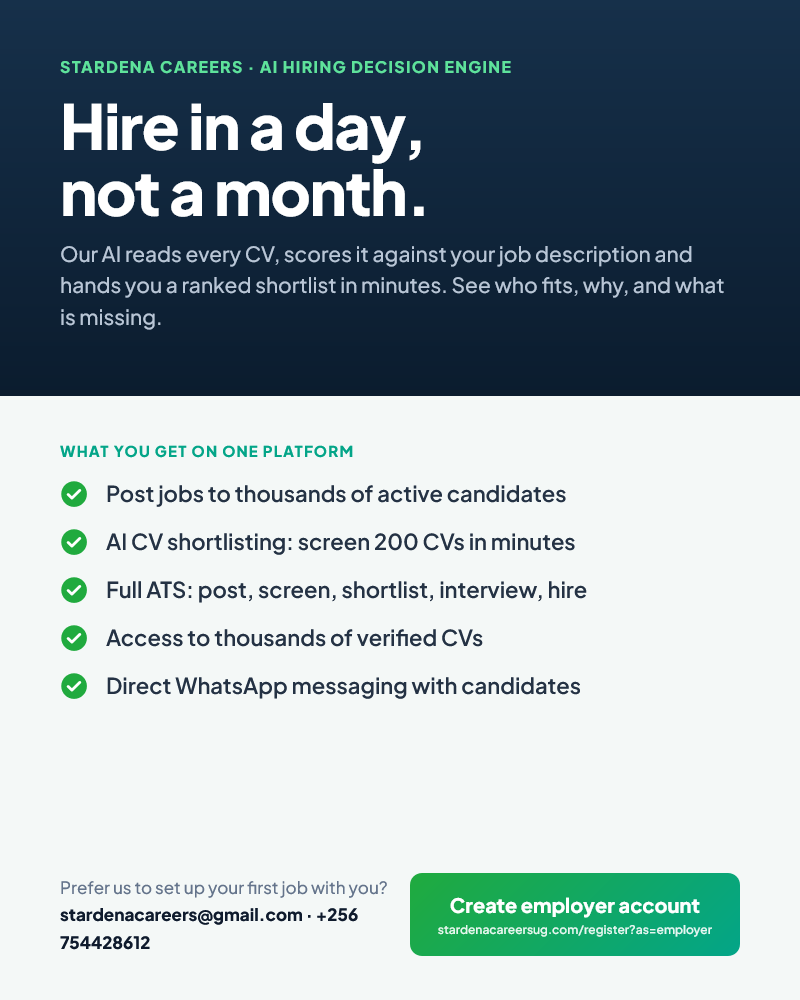
An AI shortlisting tool reads every CV you upload. It compares each one against the job description you provided. It produces a score out of 100, a short summary of why the person fits or does not, a list of skills that matched, and a list of what is missing. Then it ranks the entire list from best-fit to least-fit.
What it does not do: it does not hire anyone. It does not replace your judgment. It does not care what university the person attended, what their surname is, or how well the CV is typeset.
It reads the content. It compares skills and experience to what the job actually needs. It gives you a starting list — the top twenty out of three hundred — and lets you do the part that humans are good at: interviewing, assessing fit, and making the final call.
That last part is important. If you think of the tool as a decision-maker, you will be disappointed. If you think of it as the intern who reads all 340 CVs overnight and hands you the twenty most promising in the morning, you will wonder how you ever worked without it.
A real example
Picture a mid-sized logistics company in Kampala. They were hiring a Finance Manager. Salary band was competitive, so they got 287 applications in nine days.
Without AI, the finance director would have blocked two full evenings to read through them. Realistically, he would have skimmed at least half. In practice, the shortlist would have been built from the first 60 CVs that "looked promising", plus a handful of referrals.
With AI shortlisting, the process was different. The director uploaded the job description and the 287 CVs. Ten minutes later, he had a ranked list. The top five were genuinely strong candidates — the kind who would have been easy to miss on page four of a manually-sorted pile. The bottom 200 were correctly flagged as junior, wrong-specialism, or unqualified. Two candidates were flagged with missing certifications that the job legally required, which saved a wasted interview.
The hire was made in eleven days. The finance director spent the week doing his actual job instead of reading CVs at night.
Why this matters more in East Africa than anywhere else
Uganda, Kenya, Tanzania, and Rwanda all share the same feature: a large and growing pool of qualified candidates, but a relatively small number of formal recruiter roles. In Europe or North America, a hiring manager can pass a task to a dedicated talent acquisition specialist. In this market, the person posting the job is often the same person reading the CVs, screening the calls, running the first interview, and making the final decision.
That is not going to change. Companies here are lean, and they will stay lean. What can change is the amount of time the generalist recruiter spends on the mechanical part of the job.
AI shortlisting does not create more recruiters. It gives the recruiter you already have the ability to see 340 CVs clearly instead of 60.

The three questions employers ask before trying this
"Will it reject good candidates because their CV is not formatted well?" No. Modern shortlisting tools read the text of the CV, not its layout. A plain CV from a strong candidate ranks the same as a designed one from a weaker candidate.
"Is this just keyword matching?" Not anymore. Older ATS systems matched keywords and stopped there. Modern AI reads context. It can tell the difference between someone who worked "in accounting" for two years and someone who led a finance team for eight.
"Do I have to change how I hire?" No. You still write the job description. You still decide who to interview. You still make the final call. The tool inserts itself between "applications received" and "shortlist built" and takes a job that used to take a week down to a morning.
What to do this week
If you are hiring now, or will be hiring soon, there are three things you can do to test whether this is worth your time.
First, take the last job you posted and count the applications. If it was fewer than forty, manual shortlisting is fine and there is no need to change anything. If it was more than a hundred, you already know you skimmed some of them.
Second, look at your last three hires. Ask yourself honestly: did the strongest candidate even make it to interview, or did the best person in the pile get missed? If you cannot answer that with confidence, the pile was too big for manual review.
Third, try it on one job. Upload the CVs, paste the description, see what comes out. If the shortlist looks close to what you would have picked manually, you have your answer. If it does not, you have lost an hour.
Where to start
We built the Hiring Decision Engine inside Stardena Careers specifically for this problem. You upload the CVs you already have, paste in your job description, and get a ranked shortlist with scores, strengths, gaps, and red flags. It is included in the employer plans — no separate tool to buy.
If you want to see it on your own hiring, create an employer account and try one job:
https://stardenacareersug.com/register?as=employer
If you would rather have someone walk you through it, email us at stardenacareers@gmail.com or call +256 754428612. We will help you post your first job and run your first shortlist.
Hiring well is not about working harder through the pile. It is about getting through it faster so you can spend your time on the interviews that matter.